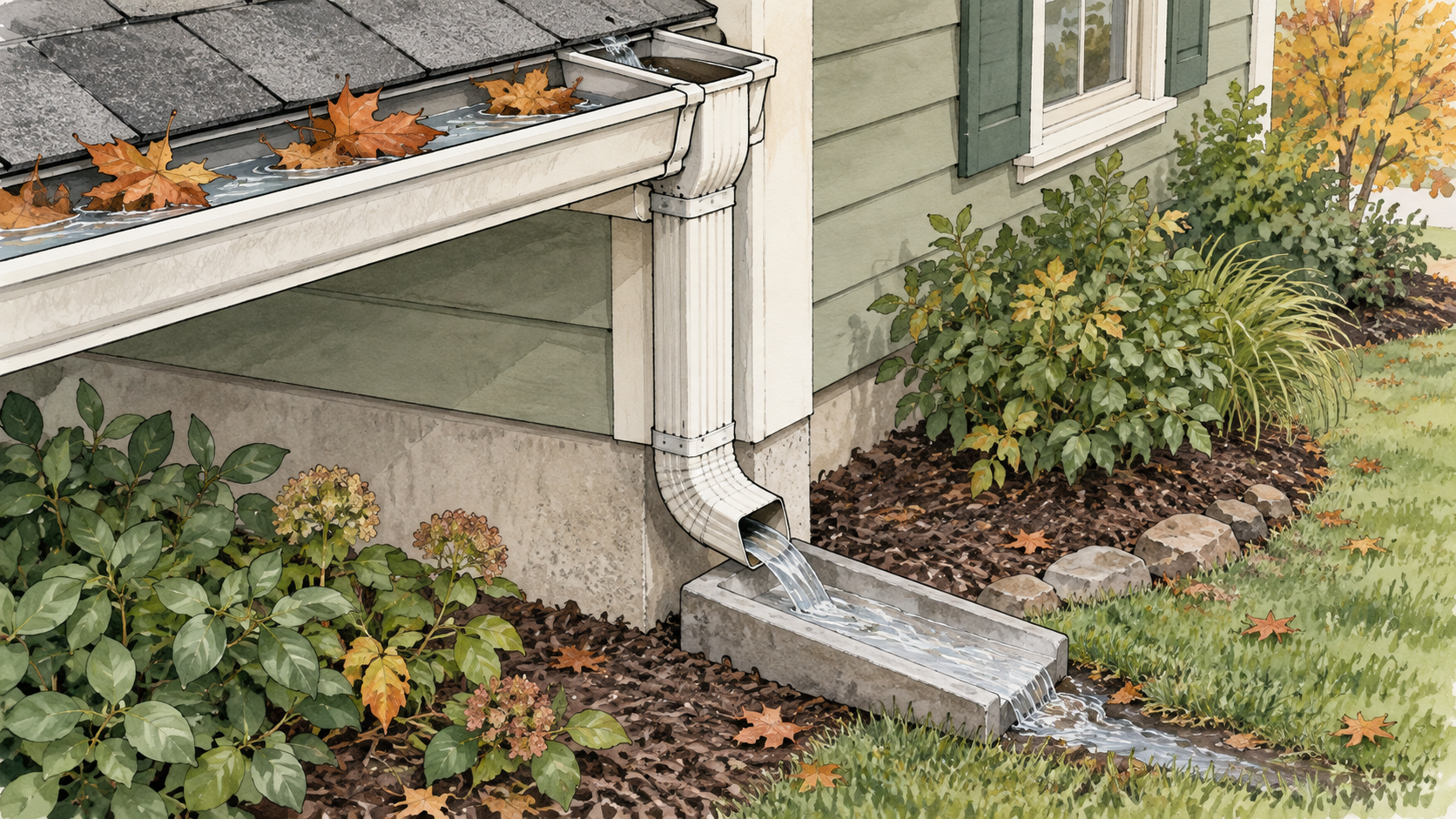
A gutter cleaning is a small appointment. Understanding where the water goes is a more useful piece of knowledge. Before you book the next visit, make a simple record of the route from your roof to the ground. You will have better questions for the person doing the work, and a way to notice whether the same problem returns.
Follow the whole route
Where a home uses gutters, the intended sequence is straightforward: the roof sheds rain into the gutter; the gutter directs it to a downspout; the downspout carries it to a discharge point that moves water away from the building. A downspout that empties beside the foundation has not completed that job. DOE’s Building America guidance treats roof drainage and site drainage as a connected system. 1
Walk around the house on a dry day and give each downspout a recognizable name: front entry, kitchen corner, garage rear. Note whether it discharges visibly or enters a buried pipe. If the destination is unknown, write “unknown.” Ask your contractor to identify it; a pipe disappearing underground does not tell you where it ends.
Notice what the next rain reveals
From a safe, sheltered position at ground level, note where water overflows, leaks at a joint, runs down a wall or collects beside the house. After the weather has passed, look for fresh staining, washed-out soil and persistent puddles. Photograph the location and the date. These observations are a brief for an inspection, not a diagnosis of the cause. 1, 4
Keep this a ground-level exercise. Arrange qualified help for elevated inspection, cleaning and repairs; do not climb onto the roof to complete the checklist. A short video of an overflow, taken safely, is more useful than a close photograph obtained at risk.
Set the schedule around this house
EPA recommends regular gutter cleaning and repair. Its broader building-maintenance guidance describes roof inspections twice yearly or according to manufacturer requirements, with additional inspections after heavy winds or rain. That is an inspection framework, not proof that every home needs exactly two gutter cleanings. 2, 4
Ask the person maintaining your gutters to recommend a schedule based on what they actually find: nearby trees, the timing of debris, roof shape, gutter protection and previous blockages. Record their reason alongside the next appointment. After a season, compare the recommendation with the photographs and visit notes. If every visit finds the same corner blocked, ask what would prevent the recurrence rather than simply accepting another identical cleaning.
Sometimes the issue is farther downstream
Clean gutters cannot correct every drainage problem. Water management may also involve the slope of the ground, patios or paths, surface drains and buried drainage. DOE’s guidance identifies these as separate parts of protecting a home from localized pooling and water entry. 3
If a puddle returns after the gutters are cleared, ask for an assessment of the full route. Before adding an extension or changing the landscape, have a qualified professional confirm an appropriate discharge point and applicable local requirements. Ask whether the proposal addresses the observed problem or only relocates it. Keep the landscape designer and drainage contractor working from the same marked plan.
Make the appointment specific
Send your observations when booking, then ask for a written scope. A useful conversation separates routine cleaning from investigation and repairs. Confirm what is included before the visit, especially where there are gutter guards or buried connections.
- Which gutter runs and downspouts will be checked, and which areas are outside the scope?
- Will the visit establish where the water discharges, or does that need a separate assessment?
- Can the contractor provide before-and-after photographs and identify defects that remain?
- If they propose a repair, what finding supports it and how will successful drainage be checked?
Keep one drainage record
EPA’s maintenance guidance recommends keeping inspection records, drainage information and photographs. 4 For your home, this can be a single folder containing a marked sketch, the contractor’s report, the invoice and any warranty. Add the name of the person responsible for the next visit.
After the next comparable rain, take a photograph from the same safe location. Label the result plainly: “overflow no longer seen,” “puddle returned,” or “not yet checked.” This turns a completed appointment into a documented outcome, and gives the next professional a useful starting point.
The useful next step
Identify each downspout and its destination, note anything unknown, and ask for a maintenance plan that follows the water all the way away from the house.